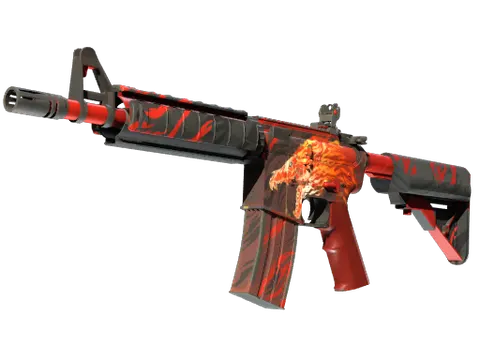


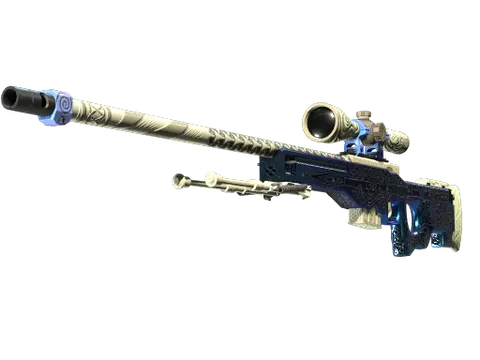

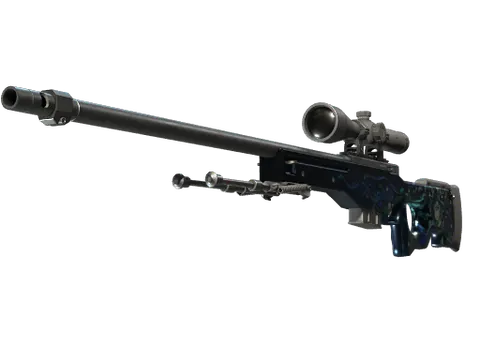
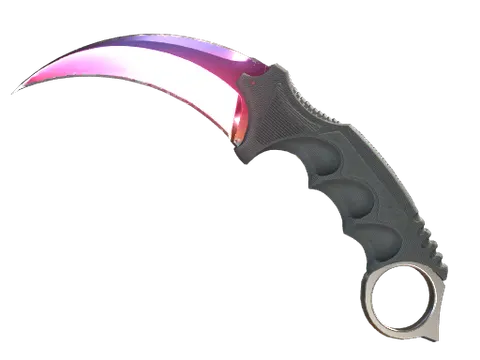
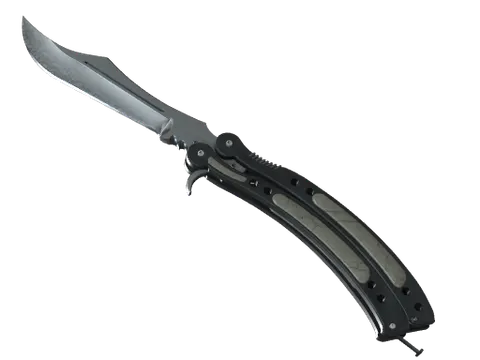
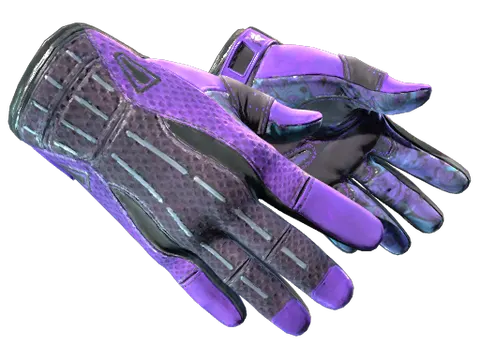

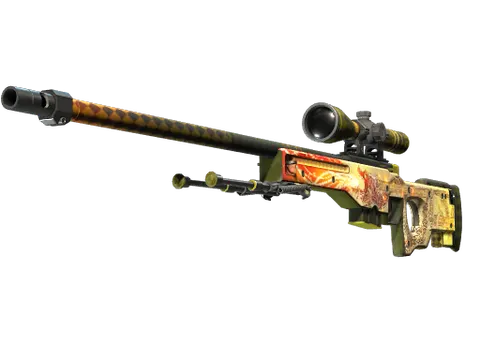
AWP | Dragon Lore belongs to the Cobblestone Collection, but that collection label does not establish a current case drop, an item-specific probability or a valid crafting recipe. This guide provides general information about the skin, case odds and trade-up rules; it does not provide a route to access BloodyCase or participate in its services.
BloodyCase is restricted in Australia. This link is provided for reference only: https://bloodycase.com/.
Links to the official BloodyCase site are independent and earn no commission. →
What is AWP | Dragon Lore?
AWP | Dragon Lore is a Counter-Strike weapon finish associated with the Cobblestone Collection. For someone seeking a tradable copy, its identity matters more than a promotional image: the weapon, finish name, individual condition and item shown in the eventual Steam offer should match what was selected. A cosmetic finish changes the presentation of the weapon rather than providing a gameplay advantage.
Keep collection, rarity, wear and special labels separate. A collection identifies an item family. Rarity concerns its grade within the game’s item system. Wear describes condition, while labels such as StatTrak or Souvenir concern distinct item characteristics. Knowing the collection does not establish the other properties. In particular, Dragon Lore’s item-specific rarity, exact wear range and special-version availability are not confirmed in this guide.
| Detail | What you can conclude | What you cannot infer |
|---|---|---|
| Cobblestone Collection | This is Dragon Lore’s documented collection. | That a current weapon case contains it. |
| A general rarity probability | It describes the stated category of case result. | That it is Dragon Lore’s individual drop chance. |
| An advertised Dragon Lore target | The interface is presenting a possible target. | That the exact copy is immediately withdrawable. |
| An individual Steam item | Its own details can be inspected. | That every listing with the same name is equivalent. |
Where does Dragon Lore come from—and can a case drop it?
The confirmed origin is the Cobblestone Collection. A named Valve weapon case, a current collection-drop route and a specific Souvenir package source are not verified for Dragon Lore here. There is therefore no verified case-opening route to recommend and no Dragon Lore case probability to quote. It would be misleading to substitute a general Covert percentage for that missing item-specific answer.
A collection and a container are different concepts. The collection groups finishes; the container has its own contents and distribution rules. Even when a container can award an item from a particular collection, that does not mean every item in that collection is available through it. Current availability also needs separate confirmation: historical origin does not establish that the same distribution route remains active.
Third-party cases introduce another distinction. BloodyCase cases are the operator’s own paid opening products, and the site states that they require no keys. Their names and contents should not be treated as Valve case specifications. BloodyCase also lists Dragon Cases, but the word “Dragon” is not evidence that AWP | Dragon Lore appears in a particular prize pool. Inspect the actual contents and displayed probabilities rather than relying on a name or banner.
- Find the exact AWP | Dragon Lore entry in the selected product’s current contents.
- Check whether the probability belongs to that item, a group of items or an entire rarity tier.
- Confirm whether condition and other item characteristics are specified before opening.
- Keep any Valve-container probability separate from the operator’s own case distribution.
- Do not pay for an opening when the desired item’s inclusion is unclear.
Published case odds: what a rarity percentage means
General Counter-Strike case references publish the following rarity figures. They provide context for ordinary case openings, not evidence that Dragon Lore is obtainable from a case. They are also not BloodyCase’s probabilities. The distinction matters because a chance assigned to a whole grade cannot automatically be assigned to a named skin within that grade.
| Result category | Published figure | How to interpret it |
|---|---|---|
| Mil-Spec | 79.92% | A general rarity-tier figure, not an individual skin probability. |
| Restricted | 15.98% | A category-level figure for the relevant case model. |
| Covert, normal drop | 0.64% | Does not establish Dragon Lore’s rarity or availability. |
| Covert, StatTrak drop | 0.064% | Does not establish that Dragon Lore has a StatTrak version. |
| Rare special item, normal drop | 0.26% | A knives-or-gloves category, not an AWP probability. |
| Rare special item, StatTrak drop | 0.026% | A separate published category figure, not an item-specific promise. |
These entries reproduce the categories as published; they are not a complete Dragon Lore probability model. To calculate an individual item’s chance, you would need confirmation that it is in the relevant pool and the distribution governing that item. Neither a rarity colour nor the presence of a desirable skin in promotional artwork supplies those details.
A probability applies to the opening governed by those rules. Previous unsuccessful openings do not turn the next result into an obligation. Repetition increases what you have spent; it does not create a promise that a particular item must arrive. Paid chance-based openings are 18+ activities and carry a house edge. If your objective is ownership of a specific copy rather than the opening experience, compare a known-item acquisition instead of treating repeated openings as a purchase plan.
Trade-up contracts: can you craft Dragon Lore?
“Crafting Dragon Lore” usually refers to an in-game trade-up contract, but the general contract rules do not by themselves verify a Dragon Lore recipe. Its eligibility as a current output is not confirmed here. Do not consume inputs based only on their collection label or an old recipe screenshot. The exact inputs must make the desired item an eligible output under the current in-game rules.
- The standard grade-up contract takes 10 skins of the same grade and produces 1 skin of the next grade.
- The inputs must be all normal or all StatTrak rather than a mixture of those categories.
- The output is selected from a collection represented by the inputs.
- Mixing eligible collections is allowed, so adding another collection can change the possible output pool.
- Souvenir and Contraband skins are excluded from the standard contract inputs.
- An advertised recipe still needs its individual inputs and current output eligibility checked.
The important decision is not simply whether a contract can be submitted. It is whether you understand every possible result before submitting it. A mixed-collection contract is not equivalent to a contract whose inputs all represent the same collection. Likewise, selecting a particular weapon is not the general rule that decides the output: grade and represented collections matter. A visually similar input or a similarly named finish is not a substitute for an eligible item.
Keep the standard contract separate from the Covert route
Older descriptions exclude Covert skins from the standard 10-input contract. A separate rule introduced on 22 October 2025 permits 5 Covert skins to produce 1 knife or pair of gloves from a represented collection, while 5 StatTrak Covert skins produce 1 StatTrak knife. That is not an AWP-output recipe. It should not be confused with obtaining Dragon Lore, nor used to infer Dragon Lore’s own rarity or eligibility.
Also distinguish Valve’s in-game contract from BloodyCase’s Contract mode. BloodyCase lists a mode with that name, but the shared word does not make its rules identical to Steam’s item-conversion system. For the operator’s available activities, consult the game modes guide. For an in-game trade-up, check the game’s current eligibility information before committing valuable inputs.
Wear, float, patterns and StatTrak: inspect the actual copy
A finish name is not a complete item description. In general CS2 terminology, float describes wear within a finish’s permitted range, and wear labels group condition into named bands. The way that wear looks depends on the finish. A condition label can help organise listings, but it does not replace inspection of the particular copy you would receive.
Dragon Lore’s exact float endpoints, supported wear conditions, finish-specific pattern effects and StatTrak availability are not confirmed here. No numeric wear range or pattern premium is therefore quoted. Before acquiring an item, check its current inspect details and compare those details with the listing and final Steam offer. If a seller makes a special-version claim, ask for item-level evidence rather than accepting a general description of Counter-Strike skins.
| Attribute | Practical check | Avoid assuming |
|---|---|---|
| Wear label | Match the listing’s condition to the item details. | That every finish exists in every condition. |
| Float | Inspect the individual item’s recorded wear value. | That a generic range applies to Dragon Lore. |
| Pattern | Inspect the actual appearance and any claimed distinction. | That another finish’s pattern terminology applies. |
| StatTrak | Verify the exact item designation. | That general StatTrak case odds prove availability. |
| Special labels | Check the full item description. | That a listing title alone establishes provenance. |
Pattern language is particularly easy to misuse. A pattern identifier can matter differently across finishes, so a claim borrowed from an AK-47 Case Hardened guide does not establish a Dragon Lore characteristic. Similarly, another AWP’s collection and acquisition rules are not transferable. Compare the separate AWP Gungnir and AWP Medusa guides on their own terms.
Safer ways to obtain a tradable copy
If your goal is the item itself, a known-item purchase or agreed trade avoids uncertainty over which finish you receive. It does not eliminate counterparty, account-security or delivery risk. Confirm that a real listing is available, inspect the copy and understand the delivery terms before paying or sending anything. This is general Steam and item-acquisition guidance, not a statement that BloodyCase operates a peer-to-peer marketplace.
Steam Trade Offers package the proposed items for both sides. The final offer is therefore an important checkpoint: compare what leaves your inventory with what arrives, rather than trusting a chat message describing the deal. An offer that requests your item without the expected return should not be accepted merely because someone promises to send the other item afterward.
- Inspect the exact itemCheck the full finish name, condition and individual details. Save the listing or agreed description so you can compare it with the offer.
- Protect the Steam accountUse Steam Guard and enter account credentials only through the genuine Steam sign-in flow. A trade link routes offers; it is not your password.
- Review the final tradeRead the items on both sides and verify the expected counterparty. A familiar avatar or display name is not sufficient proof.
- Read delivery restrictionsCheck Steam’s current notices for the account and item. Do not assume that a seller’s delivery claim removes a Steam restriction.
A Steam trade hold means that Steam holds items before delivery, giving an owner time to respond to a compromised-account trade. Steam Guard’s Mobile Authenticator provides additional authentication for trade and market confirmations. These are platform protections, not BloodyCase rules, and this guide does not assign a universal waiting period. If delivery is pending, read the actual Steam notice before attempting another transaction.
The Steam Community Market uses Steam Wallet funds and displays transaction-fee lines. Wallet credit, a third-party site balance and an item in your Steam inventory are different things. Compare the final payable total rather than only a headline listing amount. For account checks and impersonation warnings, use the trade-safety guide; for operator-specific charges and valuation questions, read the BloodyCase fees guide.
BloodyCase documents an Upgrader that accepts skins, optionally supplemented by balance, for a chance-based attempt at a more expensive target. Its stated chance depends on the value ratio between the stake and target. BloodyCase is restricted in Australia, so this description is informational and not an invitation to use the feature. Dragon Lore’s presence in the target catalogue is not confirmed here.
The official Upgrader screenshot illustrates the mode; it does not establish live Dragon Lore stock or a particular chance. BloodyCase is restricted in Australia, so Australian readers should not treat the screenshot or displayed terms as an invitation to participate. No fixed Dragon Lore upgrade percentage, target-specific fee or cashback rate is stated in the published mode description.
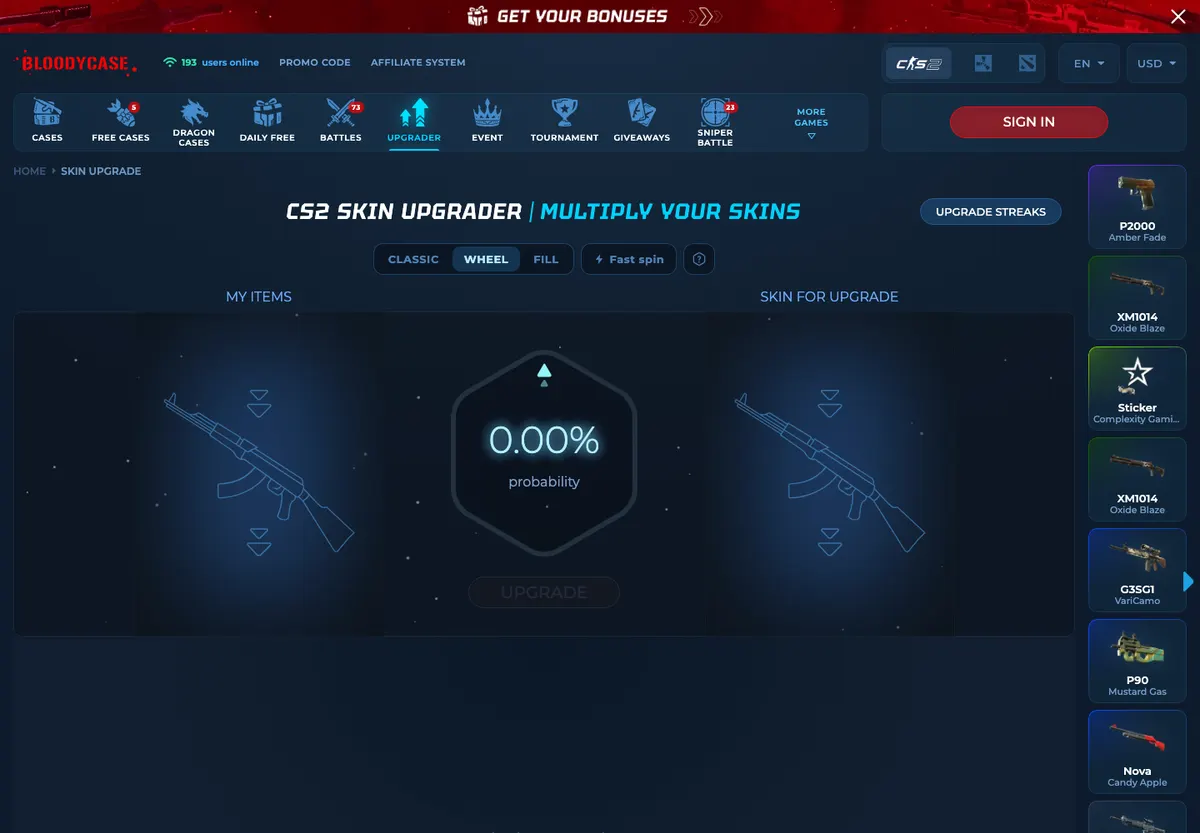
The official Upgrader screenshot illustrates the mode, not proof of live Dragon Lore stock or a particular chance. Read the chance shown on the official site before each attempt. If the item details, stake valuation or probability are unclear, do not proceed. No fixed Dragon Lore upgrade percentage, target-specific fee or cashback rate is stated in the published mode description.
BloodyCase is restricted in Australia. This link is provided for reference only: https://bloodycase.com/.
Links to the official BloodyCase site are independent and earn no commission. →
Understand what is at stake before confirming
BloodyCase says an unsuccessful Upgrader attempt results in the staked skin or balance being lost and cashback being credited. Cashback should not be treated as cancellation of that loss; its amount and conditions are separate. Adding balance also changes the amount at risk. An upgrade is not a partial payment towards ownership, and an unsuccessful attempt does not create progress that makes the target owed later. BloodyCase is restricted in Australia; this is general information, not an invitation to participate.
This is an 18+ game of chance with a house edge. The operator’s margin means the long-run expected result is a loss, even though an individual attempt can succeed. Timing, animation patterns and previous results do not improve stated odds. BloodyCase is restricted in Australia, where online casino and slot services to Australians and their advertising are prohibited.
Decide in advance what you can afford to lose and stop when that boundary is reached. Do not increase a stake to recover a failed attempt or risk skins you would be distressed to lose. If the purpose is to own Dragon Lore, comparing an inspected copy is an alternative to a chance-based attempt. BloodyCase is restricted in Australia; the responsible-gambling guide explains warning signs and ways to set boundaries.
Verification and withdrawal are separate checks
BloodyCase states that its openings, including battles, use a provably fair algorithm with server-seed verification. Provably fair verification concerns whether a result follows the committed process; it does not make a desirable result likelier or remove the house edge. Before relying on that label for an upgrade, check the verification information available for that mode. The provably fair guide explains the distinction between checking a result and predicting one.
BloodyCase says won skins can be withdrawn to Steam, sold for site balance or used in Upgrade and Contract modes. It also states that Steam withdrawals require a balance top-up of at least $5. That requirement is not a Dragon Lore price, a reservation payment or a promise of availability. Confirm the current withdrawal requirements and inspect the eventual Steam offer. For the broader service assessment, read the BloodyCase review and deposit and withdrawal guide.
Dragon Lore decision checklist
- For a case opening: verify that the exact item is included and read its own displayed probability.
- For a trade-up: confirm current output eligibility rather than relying on collection membership alone.
- For a purchase or trade: inspect the individual copy and compare it with the final Steam offer.
- For a BloodyCase upgrade: check target availability, stake valuation, displayed chance and loss terms.
- For withdrawal: distinguish site balance from a delivered Steam item and read any platform restriction.
- If any essential detail is unclear: pause rather than substituting a general rarity figure or promotional claim.
AWP | Dragon Lore FAQ
No matching questions found.
What collection is AWP | Dragon Lore from?
Which case drops Dragon Lore?
Is the Dragon Lore drop chance 0.64%?
Can you craft Dragon Lore with a trade-up contract?
What is Dragon Lore’s float range, and does pattern matter?
Does a StatTrak Dragon Lore exist?
Can I upgrade to Dragon Lore on BloodyCase?
Does provably fair make a Dragon Lore upgrade more likely to succeed?
BloodyCase is restricted in Australia. This link is provided for reference only: https://bloodycase.com/.
Links to the official BloodyCase site are independent and earn no commission. →
This independent guide is for informational purposes and is not affiliated with BloodyCase.