






This independent guide explains published fees and prices for informational purposes; it does not provide instructions for accessing or using the service. BloodyCase documents a $5 minimum deposit, says no case keys are needed, and lets users sell won skins for site balance or withdraw them to Steam. It does not publish a complete fixed commission schedule or sell-back formula in its public explanations. Case opening and other games of chance are 18+ and carry a house edge.
Visit https://bloodycase.com/ for information about the service. BloodyCase is restricted in Australia.
Links to the official BloodyCase site are independent and earn no commission. →
Start with the published costs and requirements
The clearest published figures are funding requirements, not commission rates. A minimum tells you whether a transaction has a stated threshold; a fee tells you how much is deducted for a service. Those are different questions. BloodyCase says its deposit requirement for paid cases and top-up requirement for Steam withdrawals are eligibility conditions, not necessarily separate charges. These published terms do not change the restriction on BloodyCase in Australia.
| Cost or requirement | What BloodyCase publishes | What it means for your budget |
|---|---|---|
| Deposit minimum for paid cases | $5 | A minimum top-up, not a stated commission. |
| Requirement to withdraw items to Steam | A balance top-up of at least $5 | An eligibility condition, not a published withdrawal fee. |
| Separate case key | No keys are needed | Do not add a separate Steam-style key price to the BloodyCase case price. |
| Case-opening price | Use the current price shown for the selected case | There is no universal opening price to apply across the catalogue. |
| Deposit commission | No complete fixed public schedule | Check the final payment quote and your provider's terms. |
| Steam item-withdrawal commission | No fixed public rate stated | Confirm any displayed deduction before requesting an item. |
| Sell-back commission or spread | No fixed public rate or valuation formula stated | Use the actual balance offer, not an assumed resale percentage. |
| House-edge percentage | No universal percentage stated | Do not treat an unspecified commission as proof that play has no mathematical cost. |
Read a case price as an entry cost, not an item quote
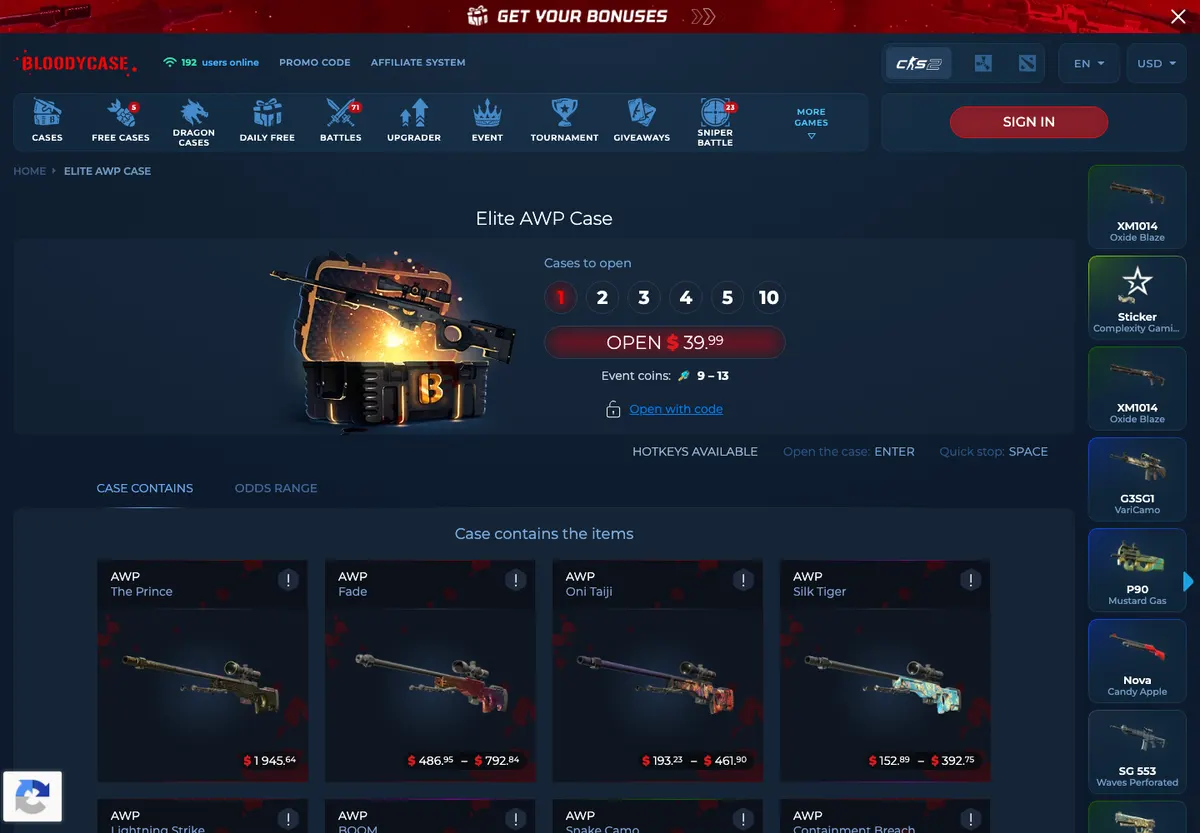
BloodyCase offers CS2 cases and also mentions Rust and Dota 2 cases. Its published case-opening model does not require a separate key, and it describes prices as varying by case. These are descriptions of the service, not an invitation to participate. BloodyCase is restricted in Australia.
BloodyCase does not publish a complete formula explaining how it sets every case price. Its public information does not establish that a case price equals the average value of its contents, tracks Steam listings automatically, or includes a particular margin. This is general context about published pricing information, not guidance to open a case.
Compare the exact skin, not just its name
As general skin-market guidance, apparently similar items can have different values. For CS2, wear condition, float, pattern, StatTrak status and attached stickers can affect comparisons. Rarity describes an item's classification; it does not establish a guaranteed selling price or reliable demand. An asking price is also different from a completed sale. These are market concepts, not a published BloodyCase pricing formula, and the relevant attributes differ between games.
- Match the game, item name and exact variant before comparing values.
- For CS2, check wear and any other attributes that materially distinguish the item.
- Keep the displayed item valuation separate from the amount offered when selling it for balance.
- Check whether an outside comparison is an asking price, a completed transaction or an estimated value.
- Use the current confirmation amount rather than a screenshot or an earlier quote.
Compare deposit methods by the final credited balance
BloodyCase lists card, wallet, voucher, cryptocurrency and skin-related payment options. Availability depends on country of residence, so the published list is not a promise that every method is available everywhere. Nor is a listed deposit method evidence of a matching cash-withdrawal route. For general information about published funding and item-transfer terms, see the deposit and withdrawal guide. BloodyCase is restricted in Australia.
| Payment category | Options listed by BloodyCase | General cost checks—not stated BloodyCase charges |
|---|---|---|
| Cards | Visa, Mastercard | Compare the checkout debit and balance credit; check your issuer's currency-conversion and transaction terms. |
| Wallets and payment services | Zen, Skrill, Neteller, PayPal, Sofort | Check the selected service's quote, funding source and any conversion before approving. |
| Prepaid options | Neosurf, Paysafecard | Check the voucher currency and the exact amount redeemable through checkout. |
| Cryptocurrency | USDT, Bitcoin, Ethereum, Dogecoin, Cardano, Ripple, Litecoin, Polygon, Shiba Inu | Confirm the asset, supported network, sending cost and credited amount. |
| Skin-related payments | SkinsBack | Compare the offered balance credit with the exact items you would transfer. |
As general payment information, an issuer, wallet or conversion service can affect the total cost independently of the website receiving a payment. A foreign-currency debit may differ from the amount displayed in a site's balance currency. That difference alone does not identify a BloodyCase commission. These observations are informational and are not instructions to make a payment to BloodyCase.
For crypto, inspect the sending cost and network
Cryptocurrency transfers can involve a wallet or exchange withdrawal charge and a network cost. Their treatment depends on the sending service and transaction; these are not published BloodyCase fee amounts. A token name alone does not establish that a destination supports the network selected in a wallet. This is general information, not a recommendation to transfer cryptocurrency to BloodyCase.
BloodyCase does not document a universal cheapest payment method. Costs can vary by provider, currency and transfer route. BloodyCase is restricted in Australia, so this comparison is informational and is not a recommendation to fund an account or use the service.
The examples below describe published requirements and transaction labels; they do not establish what a payment provider will charge. They are included to explain the distinction between a stated threshold and a fee, not to guide a transaction. BloodyCase is restricted in Australia.
The examples below use the published $5 requirement and transaction labels rather than inventing case prices or commission percentages. They show how a quote may be described, not what any particular payment provider will charge. This information does not recommend depositing, opening cases or otherwise using BloodyCase in Australia.
Example: the published minimum for paid cases
BloodyCase states a $5 minimum deposit for paid cases. That published threshold does not establish how many openings it buys, whether any particular case is affordable, or whether a payment provider would debit the same amount in another currency. This example explains the stated term only; it is not a recommendation to deposit or play.
Example: a welcome offer with a deposit condition
BloodyCase advertises a welcome allocation of 5 cases that requires a $5 deposit to unlock and is available once per user. This describes an offer with a funding condition; it is not a no-deposit route to items. The offer is mentioned for informational purposes only and is not a recommendation to claim it or use BloodyCase in Australia.
Example: the stated Steam-withdrawal condition
BloodyCase states that withdrawing items to Steam requires a balance top-up of at least $5. That statement describes an eligibility condition; it does not say that $5 is deducted as a withdrawal commission. A fixed public item-withdrawal commission is not stated. BloodyCase is restricted in Australia; this explanation does not invite users to fund an account or request a withdrawal.
Published descriptions distinguish selling an item for site balance from withdrawing it to Steam
BloodyCase says won skins can be sold for site balance, withdrawn to Steam, or used in Upgrade and Contract modes. These are different uses of an item, not interchangeable cash-out methods. Selling for balance converts an item into site credit; withdrawing transfers an item to a Steam account. Neither statement establishes that a bank account or crypto wallet can receive the item's displayed value. BloodyCase is restricted in Australia.
BloodyCase does not publish a universal sell-back rate or a complete explanation of how an offer relates to outside market prices. A difference between a displayed skin value and a balance offer may be relevant when interpreting the published terms, but should not be labelled a fixed commission without an explicit explanation.
The site says items from its welcome-case offering can be sold with the credit added immediately to the account balance. That is a balance-credit statement, not a general promise about Steam delivery or external payment processing. Selling a drop for balance is not the same as moving its value outside the site.
At https://bloodycase.com/, BloodyCase publishes information about its terms. BloodyCase is restricted in Australia.
Links to the official BloodyCase site are independent and earn no commission. →
Compare what you put at stake across modes
A mode can involve a cost even when no separate commission line is shown. The cost may be a case entry, an existing skin committed to an attempt, or balance added alongside an item. This is a description of how to interpret published mechanics, not a recommendation to use them. The game-modes guide explains the documented activities in more detail.
| Activity | Documented mechanic | Cost implication |
|---|---|---|
| Paid case opening | Open a selected case without a separate key | Check the live case price and treat the payment as spending on a random result. |
| Case battles | Participants open the same cases; the player with the highest total drop value takes all drops | Your own revealed drops are not necessarily items you retain after settlement. |
| Upgrader | Stake skins, optionally with balance, for a higher-value target | Count the committed items as part of the stake, not just any added balance. |
| Upgrader loss | The committed skin or balance is lost and cashback is credited | Do not assume an unpublished cashback amount offsets the lost stake. |
| Contract | Won skins can be used in this mode | Inspect the live rules and proposed item commitment; no fixed contract commission is published. |
The Upgrader says its chance is based on the value ratio between the stake and target. That does not establish a published universal margin or make a higher-value target a bargain. Similarly, cashback after a losing attempt does not undo the loss of committed items or balance. These are descriptions of the stated mechanics, not advice to make an attempt.
Understand the house edge beyond visible commissions
Case opening and similar games of chance are 18+ and carry a house edge. In general, the edge is the mathematical advantage built into the relationship between stakes, probabilities and outcomes. It is not necessarily collected as a visible service charge. A transaction can therefore show no separate commission line while the activity still has an expected cost to the player. BloodyCase does not publish a universal house-edge percentage in its public explanations.
As a general mathematical concept, evaluating a case would require the complete outcome distribution and a defensible value for each outcome. A showcase of desirable drops is not enough, and outside asking prices may not represent the balance or item value that can actually be obtained. This explanation is not a recommendation to open cases.
BloodyCase states that its openings, including battles, use a provably fair system and that results can be verified with server seeds. Verification concerns how a result was generated. It does not establish that the case is cheaply priced, that item valuations match another market, or that the house edge disappears. Use the provably fair guide for that separate verification question, and assess the price on its own terms.
Keep Steam market fees and trade holds separate
Steam Community Market transactions are distinct from BloodyCase transactions. Steam's market uses Steam Wallet funds and shows fee lines charged by Valve in its purchase interface. Those fees are not evidence of a BloodyCase commission. Any later sale of an eligible item on the Steam Community Market is subject to Steam's own current terms and quote.
Steam Wallet credit is a different destination from a payment-card refund or a crypto transfer. Comparing prices across these destinations without accounting for their different uses can make an item seem more valuable or liquid than it is. A quoted figure is useful only when its destination is clear.
A Steam trade hold is a delivery restriction, not a commission. Valve describes holds as a way to give owners time to stop fraudulent transfers, while the Steam Guard Mobile Authenticator supports trade and market confirmations. BloodyCase says its exchanges run automatically through Steam bots, but that statement should not be read as removing Steam's account or item restrictions. See trade safety for general information about unfamiliar offers and claims that a hold can be removed.
Resolve a cost discrepancy before spending again
When a payment or valuation looks wrong, the transaction stage can help explain the difference. A bank debit, a site-balance credit, a sell-back quote and a Steam trade each answer a different question. Comparing records from the same stage is more useful than assuming every discrepancy is a hidden commission. BloodyCase is restricted in Australia; this is general information, not advice to repeat a transaction.
- If your payment account shows a larger debitA difference may reflect the merchant transaction, an issuer charge or currency conversion. The relevant records can help identify its source; it should not be described as a BloodyCase fee unless the records support that conclusion.
- If less balance arrived than expectedA difference between promised and posted credit does not by itself identify its cause. Promotional credit, paid amounts and any crypto transaction record are distinct pieces of information.
- If the sell-back offer seems too lowA sell-back quote and an outside asking price may refer to different values. BloodyCase does not publish a standard discount or an unpublished refund entitlement.
- If a Steam withdrawal remains pendingA pending Steam withdrawal can reflect the site's status or a Steam offer or restriction. A delay does not establish that another payment is due. Treat requests to pay to accelerate delivery with caution.
BloodyCase advertises support at support@bloodycase.com, available 24/7. That availability statement is not a guaranteed response or resolution time. A useful fee query includes the payment method, currency, transaction reference, quoted debit, promised balance credit and the exact difference you want explained. For an item query, add the item name and a screenshot of the offer. Remove sensitive card details and never send wallet recovery phrases. The support guide helps you prepare the request.
Your final cost checklist
The cheapest-looking entry price is not always the clearest purchase. Choose only when you understand the payment debit, credited balance, full stake and intended destination of any resulting item. Set a spending limit before funding the account, and do not increase it to chase a previous loss, use a remaining balance or qualify for an offer. Further budgeting guidance is available under responsible gambling.
- Check the applicable age requirement and whether the service is lawful where you are; BloodyCase is restricted in Australia.
- Check the current case or mode price; no separate case key is required.
- Published payment amounts may be shown in different currencies; no Australian-dollar equivalent is stated here.
- Separate the $5 funding requirement from any actual transaction deduction.
- Count existing skins committed to an attempt as part of your stake.
- Before selling, read the exact balance offer; before withdrawing, inspect the item and conditions.
- Keep Steam market charges, payment-provider costs and BloodyCase quotes separate.
- Save unclear quotes and ask support before confirming or sending more money.
BloodyCase fees and prices FAQ
No matching questions found.
What commission does BloodyCase charge?
Is the $5 minimum deposit a fee?
Does BloodyCase charge $5 to withdraw a skin?
Do I need to buy a key as well as a case?
How are BloodyCase case prices and skin values set?
Which BloodyCase deposit method has the lowest fees?
Can I withdraw site balance to a bank or crypto wallet?
Are Steam fees included in BloodyCase prices?
Does provably fair mean there is no house edge?
The practical rule is to pay attention to the final quote, not an assumed commission rate. BloodyCase's documented $5 requirements and keyless openings establish useful starting points, but they do not replace a transaction-level cost check. In Australia, the brand is restricted and the law prohibits online casino and slot services to Australians and their advertising. If the debit, balance credit, item value or withdrawal condition remains unclear, leave the action unconfirmed until you have an explanation.
Visit https://bloodycase.com/ for information about the service. BloodyCase is restricted in Australia.
Links to the official BloodyCase site are independent and earn no commission. →
This independent guide is for informational purposes and is not affiliated with BloodyCase.