






Protecting your money, items and time matters more than opening another case or completing another trade. This guide from bloodycase.us.com explains how to set boundaries, recognise warning signs, request account restrictions where offered and find local support. We are an independent, adult-only information website about BloodyCase—not the operator. Case opening and other games of chance are 18+ activities, carry a house edge and can result in the loss of money or valuable items. Choosing not to participate is always a valid option.
Understand what this website can—and cannot—do
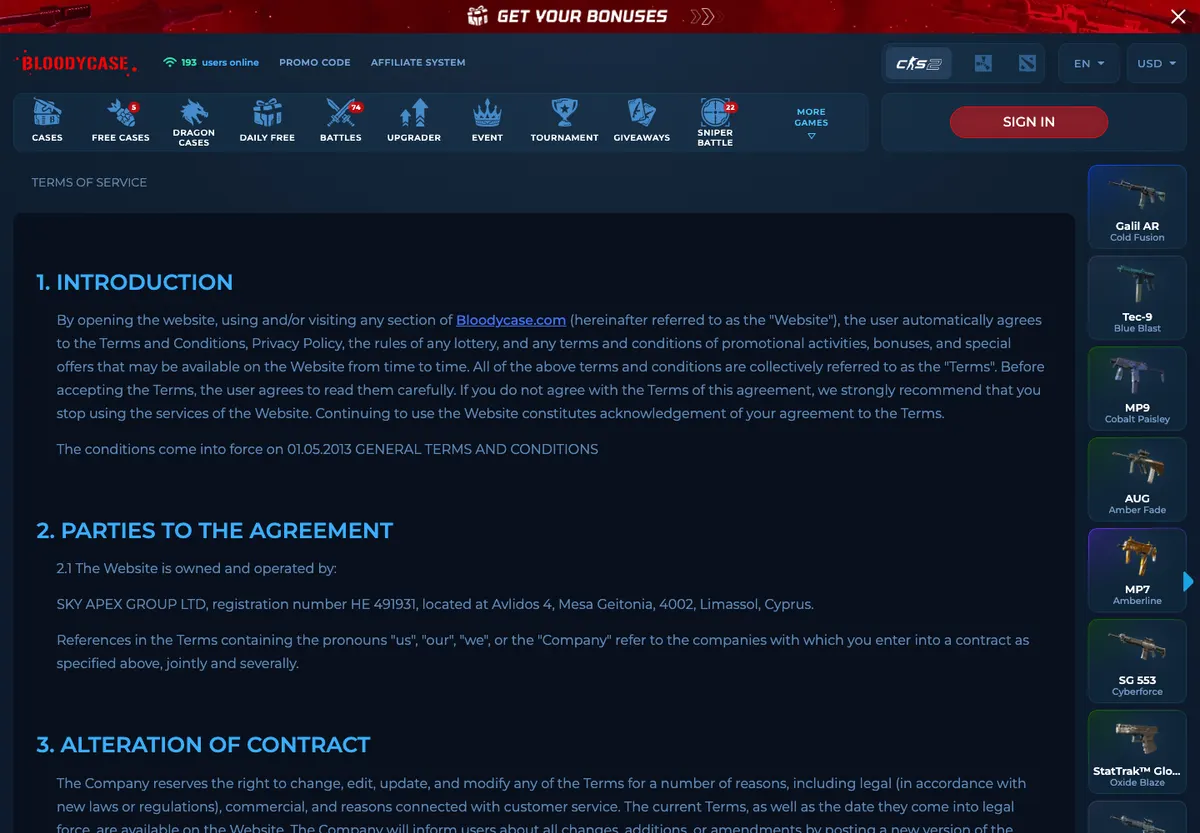
bloodycase.us.com is published by SmgTev as an independent guide about BloodyCase. We publish brand facts only with sources and distinguish those facts from general safety advice. This page describes our approach to safer use and gives practical guidance; it is not BloodyCase's responsible-gambling policy or a substitute for the operator's current terms. We do not operate case openings, provide a cash-out marketplace or handle gambling transactions.
Our buttons linking to BloodyCase lead to its official website at https://bloodycase.com/. BloodyCase pays nothing for these links, and we earn no commission from them. A link is not a recommendation to spend or evidence that an activity is suitable for you. You can read this guidance without visiting the operator.
- We have no access to user accounts, balances, inventories or trades.
- We cannot stop deposits, reverse a result, recover an item or apply an operator account restriction.
- We can receive feedback about this website and correct or clarify our editorial content.
- Account-related requests must go to the relevant operator, payment provider or Steam support channel.
Keep adult eligibility separate from availability
This website is for adults aged 18+ only. BloodyCase's published site wording separately says its service is available only to people who have reached the age of majority. Our adult-only rule does not establish your eligibility to use an external service: follow the age requirements and location restrictions that apply to you, including any higher applicable age requirement.
An accessible webpage, familiar game logo or available payment option is not a reason to assume participation is permitted. Check the operator's current terms and relevant local guidance before using a service. Do not use another person's identity, account or payment method, and do not bypass age or location controls. If eligibility remains unclear, do not deposit while trying to resolve it.
Treat skins and account balances as real spending
An item can feel less tangible than money leaving a bank account, but losing something you value still matters. Keep separate records of money paid, items transferred and balances reused. BloodyCase states that won skins can be withdrawn to Steam, sold for site balance or used in its Upgrade and Contract modes. Those options should not be treated as financially interchangeable.
| What you hold | How to think about it |
|---|---|
| Money available for essentials | Keep it outside any gambling budget, including money for bills, food, housing and repayments. |
| An item in your inventory | Decide whether you are genuinely willing to lose it before placing it at risk. |
| An operator account balance | Do not assume it has the same uses or withdrawal conditions as money in your bank. |
| Steam Wallet funds | Steam's Community Market uses Wallet funds; do not treat that balance as a bank balance. |
This is a budgeting distinction, not a valuation service. A displayed item price does not establish what you could receive elsewhere. Avoid counting an uncompleted withdrawal or an estimated inventory value as money available for household spending. Our deposit and withdrawal guide explains documented operator information separately from this general advice.
Set a spending boundary before opening the site
A useful budget is a stopping rule, not a target to spend. Set it while you are away from the activity and not reacting to a result. Being able to afford a loss does not, by itself, make participation healthy: your sense of control, wellbeing and other commitments matter too. Not allocating any money is a complete and reasonable plan.
- Protect essential money firstExclude bills, food, housing, debt payments, savings commitments and money belonging to someone else. Do not borrow, use credit to chase a result or sell possessions to continue.
- Choose a clear maximum lossWrite down what you are prepared to lose in full over a defined period. Include item value as well as deposits. Do not increase that boundary because earlier spending has already happened.
- Count spending across servicesKeep a combined record rather than treating every website, game mode or payment method as a fresh budget. Changing where you play does not undo the earlier spending.
- Decide how you will stopUse relevant account or payment controls where offered, set an external reminder and tell a trusted person if that helps. Do not rely only on remembering your limit during play.
- Review away from the activityCompare your plan with what happened after the session, without depositing again. Repeatedly exceeding your own boundary is a reason to stop and seek support, not simply to write a larger budget.
Include reused balances and items
A session can continue without another bank payment if you keep putting items or credited balances back into play. Record that activity rather than describing it as costless. Keep the value you place at risk visible, even when the interface makes reuse convenient. If tracking becomes confusing or you find yourself avoiding the record, pause instead of assuming the remaining balance represents an acceptable amount to lose.
Keep a record that does not hide the pattern
Keep deposits, completed withdrawals, item transfers and repeated stakes in separate columns. Reusing the same balance is activity to record, not fresh outside income. Likewise, moving an item between your own records should not make it look as though you acquired extra value. Retain the original transaction details instead of forcing everything into a single running total. If an item valuation is uncertain, label it as an estimate rather than spendable money.
The aim is honest visibility, not perfect accounting. Note when you intended to stop and whether you continued, because a financial total alone can miss a loss of control. You can share a simple summary with a support worker without giving them account access. Do not delay seeking help because your records are incomplete.
Protect your time as well as your balance
Set an end time before starting, independently of whether the session is going well or badly. A spending boundary does not prevent lost sleep, missed work or being mentally occupied by results long after closing a page. Avoid participating when distressed, exhausted or affected by alcohol or other substances. If your aim is to escape a difficult feeling, choose an activity that does not put money or items at risk.
- Use a timer outside the operator's interface, and stop when it sounds.
- Keep gambling away from work, study, caring responsibilities and bedtime.
- Disable promotional notifications where possible if they pull you back into the activity.
- Take breaks away from case-opening streams and related social feeds, not just away from the operator.
- Do not extend a session to finish on a preferred result or recover an earlier loss.
Make the environment support your decision. Where settings allow, remove saved payment methods and automatic sign-in so that returning is less immediate. Put a planned offline activity after your stopping time rather than leaving the rest of the evening unstructured. These changes add friction; they do not restrict an operator account or replace specialist support. If you keep undoing them, treat that as useful evidence that a stronger barrier may be needed, not as a reason to abandon the attempt to stop.
Understand what fairness does not protect against
BloodyCase states that its openings, including battles, use a provably fair system and that results can be verified using server seeds. That is a statement about checking results, not a promise that an opening will return what you spent. Our provably fair guide addresses the documented verification information; this page focuses on the decision to put value at risk at all.
Games of chance carry a house edge: a mathematical advantage for the operator. A fairness check does not remove that advantage, protect your budget or make continued play a reliable way to recover losses. A run of disappointing outcomes is not a reason to expect the next attempt to repay you. Changing the presentation or choosing another mode is not a substitute for stopping.
For example, BloodyCase describes its Upgrader as allowing skins, optionally with balance, to be staked toward a more expensive target, with the stake lost on an unsuccessful attempt and cashback credited. Cashback does not mean the original stake is protected. Describing the goal as an upgrade does not remove the possibility of loss. Decide whether you accept losing the item before proceeding, not after seeing the result.
Recognise warning signs early
Look at the effect on your life, not only the size of a deposit or inventory. The following are reasons to pause and consider support; they are not a diagnostic test.
- You return mainly to recover money or replace a lost item.
- You spend longer or put more value at risk than you intended.
- You hide deposits, trade history or the amount of time spent.
- You use money intended for essentials or ask others to fund continued play.
- You feel irritable, anxious or preoccupied when trying to stop.
- You neglect sleep, work, relationships or responsibilities.
- You repeatedly change your own rules after a disappointing result.
- You create another route to play after deciding to block access.
- You feel unable to enjoy other activities without checking results or offers.
You do not need to identify with every sign. If the activity feels difficult to control or someone you trust has expressed concern, take that seriously. Asking for help early does not require accepting a label, proving a financial crisis or explaining your experience perfectly.
Choose your next step based on what is happening
| Situation | Safer next step |
|---|---|
| You have not started and feel unsure | Do not deposit. Read the rules away from promotional content and consider whether participation fits your priorities. |
| You reached a money or time boundary | End the session. Do not negotiate a new boundary while reacting to results. |
| You want to recover a loss | Close the activity, step away and speak to someone before making another financial decision. |
| You repeatedly cannot follow your plan | Seek specialist support and ask about stronger account restrictions or self-exclusion where offered. |
| You suspect account theft or a fraudulent trade | Stop interacting with the sender, preserve evidence and use official account-security channels. |
| You are in immediate distress or danger | Contact local emergency help rather than waiting for a website or operator reply. |
Request a break or self-exclusion where offered
A personal decision to take a break is different from an account restriction applied by an operator. Self-exclusion, cooling-off periods, deposit controls and marketing preferences are also different tools; their availability and scope depend on the service. Ask for the restriction that matches your needs and obtain confirmation rather than assuming that logging out or deleting a shortcut has restricted the account.
- Stop the activity while arranging helpDo not keep playing while waiting for a reply. Move away from the interface and ask a trusted person for support if that would make stopping easier.
- Contact the operator directlyBloodyCase publishes support@bloodycase.com as its support email. State clearly that your request concerns gambling-related harm and that you want information about available account restrictions or self-exclusion.
- Ask what the restriction coversRequest written details about its scope, duration, effective status, marketing treatment and any conditions for later access. Ask separately about handling an existing balance or pending item withdrawal.
- Add barriers outside the accountConsider device or website blocking tools and ask your payment provider about available gambling controls. Their coverage can vary, so do not assume a block catches every skin-related transaction or alternative route.
- Arrange support beyond blockingKeep the confirmation and contact a local gambling-support service. Restrictions can help create distance, but they are not a substitute for help with distress, debt or repeated urges to return.
If a remaining balance keeps pulling you back
Ask support how the balance or pending items can be handled alongside your restriction request. Do not put them through another game merely to simplify the account or reach a preferred amount. If returning to the interface triggers further play, explain that in your request and ask about a support-led process. We cannot access the account, resolve its balance or apply an exclusion on your behalf.
Plan for an urge before it arrives
Write a short response plan while you are away from gambling. Identify the situations that tend to precede a return, such as boredom, an argument, payday or watching case-opening content. Then decide what you will do instead and whom you can contact. Keep the plan somewhere accessible without opening the operator's website. A practical plan is more useful than relying on a promise that the urge will not happen.
- Leave the device or setting associated with play and begin a preselected alternative activity.
- Contact a trusted person or support service before making a deposit or transferring an item.
- If you return to play, stop again rather than treating the broken boundary as permission to continue.
- Review the route that allowed access and ask for help strengthening that specific barrier.
Keep account and trade safety separate from play
Controlling spending does not protect an account from phishing, and strong account security does not make gambling harmless. Use both kinds of safeguards. The following is general Steam and online-account guidance, not a statement of BloodyCase's withdrawal requirements. Valve describes Steam Guard Mobile Authenticator as providing two-factor authentication for trade and market confirmations.
- Open services through an address you have checked, rather than an unsolicited message, advertisement or copied login page.
- Use strong, unique passwords and available account-security controls, including protection for the email account used for recovery.
- Never give another person your password, authentication code, recovery code or access to a live session.
- Read each trade offer carefully, checking the items, direction of transfer and other party before confirming.
- Do not send an item to an alleged moderator or support agent for verification or safekeeping.
- Treat a request for a payment to unlock a prize or recover a stolen item as a reason to stop and verify independently.
- Check current Steam notices about holds or restrictions instead of accepting an explanation from a stranger.
A Steam trade hold means Steam keeps items for a period before delivery, allowing time to cancel fraudulent trades from compromised accounts. That is a general Steam safeguard, not a BloodyCase processing-time promise. Do not attempt to bypass a restriction by handing an account to someone else. See our trade-safety guide for a separate review checklist.
If a message or trade looks suspicious
Stop replying and do not approve further confirmations. Preserve the message, relevant address, trade details and screenshots without sharing credentials. Navigate independently to the affected service's official security and support pages. If you entered credentials on a suspicious page, follow that service's current account-recovery guidance promptly. Report any unauthorised payment to the relevant payment provider. Do not pay a person who promises recovery, and do not gamble in an attempt to replace the loss. Our publisher cannot investigate Steam accounts or reverse trades.
Keep a delayed transfer out of your gambling decisions
If a transfer appears delayed, separate troubleshooting from further spending. Check any available transaction status and ask the relevant service for an explanation through its official support route. Keep the transaction reference and describe what happened, but redact unrelated personal information from screenshots. Do not assume that opening another case, staking the remaining balance or making a fresh deposit will resolve a pending transfer. If someone makes that claim, verify it independently before taking any action. An unresolved account issue does not prevent you from seeking gambling support or requesting a restriction.
Do not let offers decide your boundaries
Read an offer's conditions before considering it, but do not treat a reward as a reason to increase spending. Ask whether you would still make the same decision without the promotional wording. If the answer is no, step back. An offer does not change your essential expenses, restore a previous loss or make an unwanted session worthwhile.
You do not owe a service your continued attention because you previously participated. It is acceptable to leave an offer unused, mute related content or stop following a creator whose posts make it harder to maintain boundaries. Selected results in videos and social posts are not a basis for planning your own spending. If promotional messages conflict with a decision to stop, request their removal through the sender's available channels.
Find help that fits your location and needs
Local services differ, so use your country's public health service, gambling regulator or recognised gambling-support directory to find an appropriate organisation. Check the service's own website for current contact details, opening hours, language coverage and eligibility. You can ask for help with case opening or skin-related gambling even if a contact form uses more familiar casino or betting terminology.
- For difficulty controlling play, look for specialist gambling support or speak to a healthcare professional.
- For debt or unpaid essentials, seek independent debt advice rather than trying to solve the shortfall through further play.
- For relationship strain, ask about support for affected family members as well as the person gambling.
- For account restrictions, contact the operator; a support organisation cannot be assumed to control the account.
- For immediate danger or thoughts of self-harm, use local emergency or crisis services.
To start a conversation, you can simply say that you are spending more time or value than intended and want help stopping. You do not need a complete transaction history before reaching out. If privacy, language or cost is a concern, ask the provider about those matters before sharing sensitive details. Do not wait for an operator dispute to be resolved before seeking emotional or practical support.
Make the first conversation easier
If it helps, write down what you want assistance with: stopping access, managing urges, protecting essential expenses or talking to someone close to you. Explain that the activity involves money or digital items being put at risk for a chance-based result. You do not need to teach the adviser every game mode before discussing its effect on your life. Ask what the next step involves and how to get back in touch. If a service cannot help with your particular circumstances, ask it to suggest a more suitable local organisation rather than assuming no support is available.
Support someone without taking over their account
Choose a calm moment and describe what you have noticed without arguing about individual results. Missed bills, lost sleep or repeated broken plans are useful starting points. Listen to what the person says they need, while maintaining your own financial and personal boundaries. You can seek support for yourself even if they are not ready to do so.
- Offer to sit with them while they contact a support service or request account restrictions.
- Do not share passwords, lend an account or provide money for another attempt.
- Protect shared essential expenses and seek independent advice about financial concerns.
- Avoid promising secrecy if there is an immediate safety risk.
- Agree on practical next steps rather than demanding a promise that everything will change at once.
Contact the publisher about this guide
For a correction, unclear explanation or concern about content on bloodycase.us.com, contact publisher SmgTev at tevezmc32@gmail.com. Identify the page and explain what needs attention. Do not send passwords, authentication codes, identity documents, payment-card details or private account-recovery material. We are not an emergency service, treatment provider or operator account-support team, and contacting us does not place a restriction on a BloodyCase account.
Our about page explains the website's purpose, and our editorial independence disclosure explains the relationship behind external links. For operator account questions, use the routes described in our support guide. Information here is general guidance, not personalised medical, legal or financial advice.
Responsible-play questions
No matching questions found.
Can bloodycase.us.com block my BloodyCase account?
Does a small deposit mean there is no gambling problem?
Does provably fair mean I can safely continue until I recover a loss?
What if I return after deciding to stop?
Do I need to wait for a serious financial loss before seeking help?
This independent guide is for informational purposes and is not affiliated with BloodyCase.