







To check a BloodyCase result, start with its server-seed verification information—not the opening animation. BloodyCase says its provably fair algorithm applies to all openings, including battles, and that results can be verified using server seeds. Below, learn what evidence to save, how a typical seed-and-hash check works, and how to distinguish a reproducible result from an unproven fairness claim.
Destination: https://bloodycase.com/. This is the brand's site; no licence from Canadian regulators is confirmed. Review information only.
Links to the official BloodyCase site are independent and earn no commission. →
What BloodyCase says you can verify
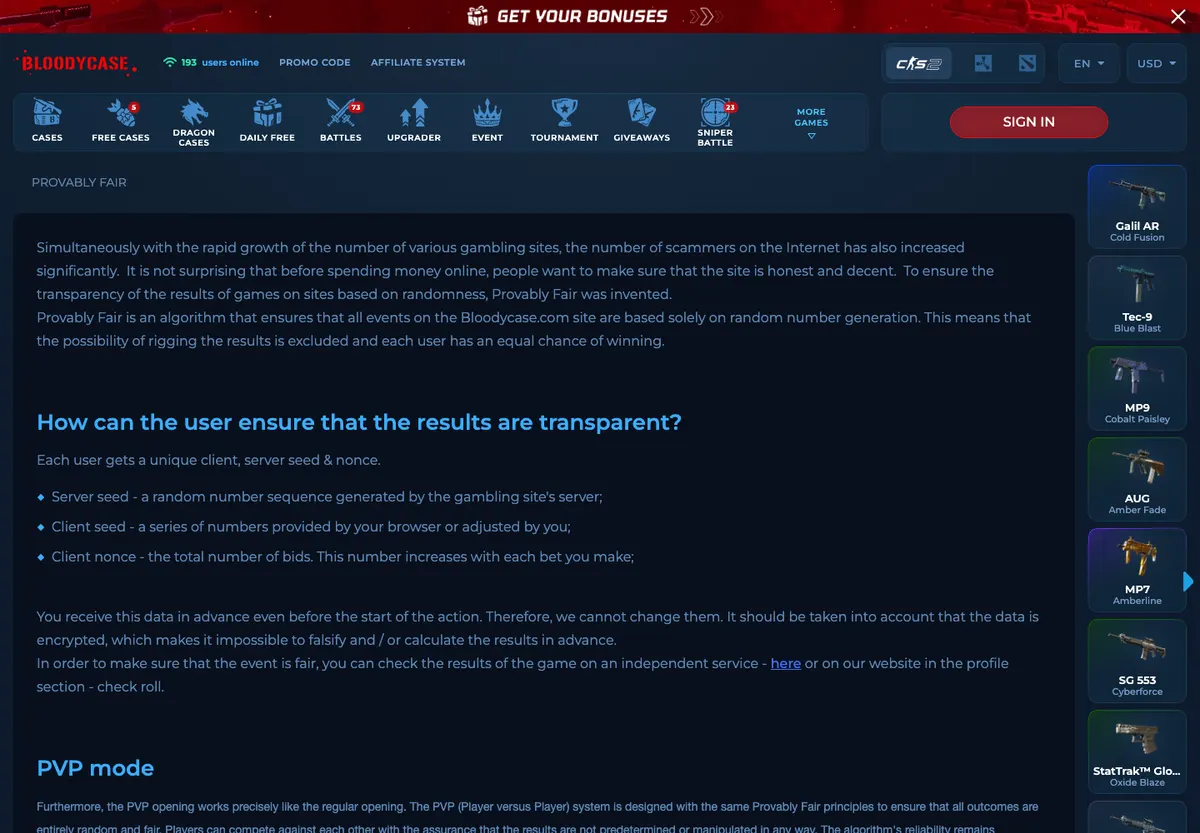
BloodyCase's documented position is that a provably fair algorithm covers all openings, including battles, and that server seeds allow users to verify results. That is a useful starting point: it identifies a mechanism intended to make outcomes checkable rather than asking you to trust an animation. It is not, by itself, a complete technical specification.
| Documented BloodyCase statement | What it tells you | What a complete check still needs |
|---|---|---|
| The provably fair algorithm applies to all openings. | The stated coverage is broader than a selected demonstration. | The exact calculation and the records for your particular opening. |
| The stated coverage includes battles. | Battle openings are expressly included in the claim. | Each relevant opening, its participant assignment, and the battle's settlement rules. |
| Results can be verified using server seeds. | Server-seed evidence is central to the advertised verification process. | The earlier commitment, revealed seed, required inputs, and outcome-mapping instructions. |
The published fairness statement does not specify the exact hash function, input formatting, seed-change rules or item-mapping formula. Obtain those details from BloodyCase's current fairness instructions or support before treating a result as independently reproduced. The workflow below explains established provably fair concepts; it does not claim that BloodyCase uses every component or option described.
Understand seeds, hashes and the result chain
In a typical provably fair design, the operator commits to secret information before play, then reveals enough information afterward for the calculation to be repeated. A cryptographic hash acts as the commitment. Recalculating that hash from the revealed secret lets you test whether it matches the earlier commitment. Repeating the outcome calculation then tests whether the recorded result follows from the disclosed inputs.
| Term | Meaning | Why it matters |
|---|---|---|
| Server seed | A secret input supplied by the operator and later disclosed for verification. | The revealed value should agree with the commitment recorded before the relevant play. |
| Server-seed hash | A cryptographic digest of the seed, produced using a specified function. | It commits to a value without normally revealing that value beforehand. |
| Client seed | A player-side input used in some systems. | Where supported, its origin and timing help explain the player's contribution to the calculation. |
| Nonce or round counter | An identifier that distinguishes calculations using an otherwise shared seed combination. | Using the wrong counter can produce a different result even when the seeds are correct. |
| Digest or intermediate output | The output generated by the documented cryptographic calculation. | It connects the inputs to the later numerical roll. |
| Roll-to-item mapping | Rules assigning calculated outcomes to items or result categories. | A matching roll alone does not establish that the correct item was awarded. |
| Algorithm version | The particular calculation and rules applicable to a recorded round. | A newer verifier may not reproduce an older result unless it supports the earlier rules. |
A hash is not an encrypted result that you can simply decode to predict a drop. A suitable cryptographic hash is designed to make recovering a sufficiently unpredictable secret impractical. Once the secret is revealed, however, checking its hash is straightforward. This difference between difficult prediction and easy later checking is what makes a commitment useful.
Timing matters as much as matching text. A hash first shown after an outcome cannot establish that the operator committed to the seed beforehand. Likewise, a matching commitment does not by itself prove that the original seed was selected without bias. The full design—including unpredictable inputs, their order of selection and the conversion method—determines what protections the commitment actually provides.
Who chooses an input, and when?
A client seed is not a magic fairness switch. In systems that support it, its purpose depends on when it becomes fixed relative to the operator's commitment. If an operator can freely choose its secret after learning every other input, a later hash match alone does not rule out searching for a preferred outcome. A sound design therefore needs a clear sequence, not merely fields labelled server seed and client seed.
When reading any fairness specification, ask which values were fixed before the opening, which remained unknown to each party, and whether either party could abandon an unfavourable calculation. These are questions about the general protocol, not allegations about BloodyCase. They explain why reproducing an outcome and evaluating the design are related but different tasks. A personal check can establish consistency for a recorded opening without amounting to a security audit of the entire system.
How to verify a BloodyCase result yourself
Begin with an existing opening record if one is available. You do not need to make another wager to understand the process. Follow BloodyCase's actual field names and instructions; where the interface does not provide a required component, stop at that point and request it. Filling a missing field with a guessed value produces a calculation, not a reliable verification.
- Identify the exact openingSave the round or opening identifier, mode, displayed outcome and available timestamp. For a case, record its identity and the item awarded. For a battle, retain the battle reference and the participant or position associated with the opening. Similar-looking histories are not interchangeable, and an adjacent opening may use a different counter or seed context.
- Preserve the commitment and applicable rulesFor future checks, retain the server-seed commitment shown before the relevant opening, together with any available algorithm instructions and case probabilities. Screenshots help document what was displayed; copyable text makes exact comparison easier. If you are examining an old result without an earlier commitment, be explicit that you may be able to reproduce a calculation without independently establishing its pre-play timing.
- Collect the required inputsUse only the inputs named in the actual algorithm. These may include a revealed server seed, client-side input, counter, round identifier or other context. Do not assume BloodyCase has a client-seed editor or uses a particular nonce convention. Preserve the original strings and field labels so that a later discrepancy can be traced to the correct source.
- Obtain the revealed seed through the stated processA secret server seed generally cannot be checked in full until it is revealed. Some systems reveal seeds after their active use ends, but that is a general design pattern rather than a confirmed BloodyCase procedure. Follow the process actually described on the site. Do not continue opening cases merely because you expect additional wagering to unlock verification.
- Recalculate and compare the commitmentApply the specified hash function to the revealed server seed using the stated encoding. Compare the complete result with the saved commitment, not just its beginning or ending. An exact match supports continuity between that seed and that commitment. A mismatch requires investigation before you move on; the subsequent outcome calculation cannot repair a failed commitment check.
- Reproduce the result calculationFollow the documented input order, separators, cryptographic operation and numerical conversion exactly. If a counter is required, use the counter for this opening rather than inferring it from the position visible in a history list. Save the intermediate output where possible. Separating input processing from roll conversion makes it easier to locate the stage at which a mismatch begins.
- Check the item mapping and record your conclusionApply the case table or outcome rules that were valid for that opening. Confirm that the calculated roll selects the displayed item or result category. Record whether the commitment, calculation and final mapping all matched, or whether part of the check remained unavailable. A useful verification conclusion states its scope instead of reducing every situation to an unexplained pass or fail.
Exact copying is part of the check
Cryptographic calculations operate on precisely defined data, not approximate visual matches. Capitalisation, spaces, line breaks and character encoding can change the input. A seed that looks shortened in the interface may not be the complete seed. Keep an untouched copy of the original values, and make any formatting adjustments only where the specification explicitly requires them. Avoid repeatedly editing fields until a verifier displays a favourable answer.
Use a verifier without surrendering account access
An official verifier can be convenient, but independently reproducing the calculation gives you a stronger understanding of what it checked. Any separate tool must implement the same documented algorithm; a generic seed calculator is not automatically compatible. Verification of disclosed round data should not require your Steam password, authenticator code, recovery information or approval of a trade. Reject tools or messages that make account access a condition of checking a hash.
Keep a verification record you can reopen
Store the source values separately from your working calculations. A useful record contains the opening reference, copied inputs with their original labels, saved instructions, intermediate outputs and a short conclusion. Note where each value came from and when you obtained it. This makes the check repeatable if the live interface changes or a support reply supplies a missing rule. Screenshots and plain text serve different purposes: the screenshot preserves context, while text helps avoid transcription mistakes.
Before sharing that record publicly, remove unrelated account details, browser-session information and personal data. Share only intentionally disclosed verification inputs, not credentials or private account material. Someone checking your arithmetic needs the relevant calculation data, not access to your Steam account or permission to move an item.
Destination: https://bloodycase.com/. This is the brand's site; no licence from Canadian regulators is confirmed. Review information only.
Links to the official BloodyCase site are independent and earn no commission. →
Check how the calculated result becomes a skin
A valid seed hash is only the commitment layer. Case opening also needs a defined route from cryptographic output to a numerical result, and from that result to an item. In a typical interval-based design, each item occupies a defined portion of the possible result range. The calculated result selects the interval it falls into. Other designs are possible, so use the mapping actually documented for the opening rather than substituting a familiar model.
Boundary rules matter. The specification must make clear which item receives a result that falls exactly at an interval edge, how precision is handled, and whether any intermediate value is rounded or truncated. A small-looking implementation difference can select a neighbouring item. If a verifier reproduces a roll but cannot show how that roll maps to the historical case contents, your check is incomplete at the item-selection stage.
Preserve the applicable case table rather than relying on a later page view. If contents or probabilities change, the current display may not describe an earlier opening. Also distinguish the selected skin from its displayed value: verifying item selection does not independently validate a price. For CS2 items, wear, float, pattern and special variants are separate descriptive attributes. Determine which attributes the recorded outcome specifies before deciding that an item name alone is a complete match. See the case-opening guide and skin terminology glossary for context.
Keep battle and Upgrader checks mode-specific
Battles require opening checks and settlement checks
BloodyCase explicitly includes battles in its provably fair claim. Its documented battle rules say participants open the same cases and the player with the most valuable total drop takes all drops. That creates distinct questions: whether the individual openings were generated correctly, whether results were assigned to the correct participants, and whether the final totals and winner followed the applicable rules.
Checking only your own drop does not settle the whole battle. Retain the relevant participant and round references, inspect the openings that determine the outcome, and compare the values used for settlement. If a tie or unusual state appears, request the applicable rule rather than borrowing one from another site. An opening verifier may address randomness without checking the battle's accounting.
Upgrader outcomes need their own probability rule
BloodyCase describes an Upgrader where users stake skins, optionally with balance, for a more expensive target, with chance based on the value ratio. A case's item table is not an appropriate substitute for that calculation. For an Upgrader check, identify the recorded stake, target, displayed chance and success condition, then obtain the mode's exact verification method. Do not infer that a general fairness statement supplies these implementation details. The game-modes guide explains the documented differences between activities.
Know what a successful verification does not prove
- It does not remove the house edge. A correctly generated outcome can still come from a prize distribution whose expected return is below its cost.
- It does not certify item prices. The calculation can select the documented item without establishing whether the displayed valuation is competitive.
- It does not prove withdrawal delivery. Randomness, site inventory handling and the eventual Steam trade are separate processes.
- It does not establish licensing or local eligibility. Cryptographic evidence is not regulator approval or permission to participate.
- It does not predict the next result. A disclosed seed for completed play is evidence about that play, not a reliable signal for another wager.
- It does not automatically validate every round. Your conclusion applies to the records, algorithm and mapping you actually checked.
Expected value is a separate calculation: combine the possible prizes with their probabilities, then compare that expected return with the cost of participation. A provably fair mechanism can reproduce a distribution without making that distribution favourable to the player. BloodyCase's fairness statement does not supply a numerical house edge, so a specific return figure should not be inferred from the presence of server seeds.
Losing streaks and repeated items are not, on their own, proof of manipulation. Equally, a valuable drop or attractive public history is not proof of fairness. The useful test is whether the saved evidence reproduces the result under the stated rules. Do not increase stakes to test a suspicion or try to recover a loss. See responsible-play guidance if checking results is becoming a reason to keep playing.
A history of drops is not the same as a proof
Looking at how often items appeared is a statistical question, while checking a seed is a reproducibility question. A short history can look uneven even when outcomes follow the stated probabilities. A public feed may also show a different selection of openings from the case or mode you are investigating. Neither an impressive sequence nor a disappointing session substitutes for the commitment and calculation associated with your opening.
A meaningful statistical review needs a clearly defined dataset, the probabilities applicable to that dataset and a method chosen before drawing conclusions. It should not be improvised from memorable wins or losses. You do not need to collect such a dataset by wagering: checking existing records and asking for the technical rules are more appropriate ways to investigate a specific result.
Troubleshoot mismatches without guessing
| What you observe | What to check | Appropriate next step |
|---|---|---|
| The revealed seed does not match the saved hash. | Complete seed text, hash function, encoding and whether the commitment belongs to this round. | Preserve both values and request an explanation; do not mark the commitment as verified. |
| The seed hash matches, but the calculated roll differs. | Input order, separators, counter, conversion method and algorithm version. | Compare intermediate outputs to identify where the calculations diverge. |
| The roll matches, but the item differs. | Historical case mapping, interval boundaries and rounding rules. | Request the mapping applicable at the opening time. |
| A required seed or rule is unavailable. | Whether disclosure is pending under the stated process or a field has been overlooked. | Record the check as incomplete rather than inventing an input. |
| The official checker passes, but another tool fails. | Whether both tools implement the same mode, version and formatting. | Do not treat an incompatible third-party checker as decisive evidence. |
| Battle openings match, but the winner seems wrong. | Participant assignment, total valuations and any applicable tie rule. | Raise a settlement question separately from the randomness calculation. |
Keep your original evidence even if you later find a copying error. A useful troubleshooting record shows what you first entered, what changed and why the corrected calculation is justified. If a discrepancy remains unresolved, describe it narrowly: for example, the commitment matches but the documented conversion does not reproduce the recorded roll. That is more actionable than a broad accusation, and more accurate than declaring success because part of the check passed.
When a checker says “pass,” inspect what passed
Suppose an old opening has a revealed seed and a result that a calculator reproduces, but you did not retain the earlier hash. You can report that the supplied inputs reproduce the outcome. You cannot personally establish from that calculation alone that the same seed was committed before play. This is a limited conclusion, not an automatic failure and not a complete historical proof.
Alternatively, suppose the seed matches your saved commitment, but the checker displays only a numerical roll. That confirms a different part of the chain. Until the applicable case table maps that roll to the recorded skin, the item-selection check remains unfinished. If the item matches but its displayed price differs from a later valuation, investigate pricing separately rather than changing the seed inputs.
Finally, if a page shows a general success indicator without explaining which inputs it used, preserve the output but ask for the underlying calculation. A result label is useful only when its scope is clear. These examples illustrate how to classify evidence; they do not describe confirmed BloodyCase interface behaviour.
Prepare a useful support request
BloodyCase lists support@bloodycase.com as its support email. If you cannot finish a check, request the missing technical component rather than a general assurance that the system is fair. Explain whether you need a seed reveal, the earlier commitment, the calculation specification or the historical outcome table. The support guide covers preparing a clear request.
- Include the opening or battle identifier, mode and available timestamp.
- Attach the saved commitment and the revealed round data relevant to the check.
- Name the verifier or documented calculation you used, including its version if shown.
- State the expected output, observed output and first stage where they differ.
- Ask for the exact missing rule, including formatting or historical mapping where relevant.
- Exclude passwords, authenticator codes, recovery information and unrelated payment details.
Keep trade safety separate from the fairness discussion. BloodyCase states that exchanges run automatically through Steam bots and that it is not affiliated with Valve. As general Steam guidance, trade offers specify items for both sides, while Steam Guard authentication helps protect confirmations. A support message about a seed does not justify accepting an unexpected offer. Review trade-safety guidance before approving any movement of items.
Your verification checklist
A strong conclusion follows an evidence chain: an earlier commitment, the correct disclosed inputs, an exact calculation and the applicable outcome rules. If a link is missing, identify it. You can acknowledge that the available values are internally consistent without claiming to have established everything about seed timing, distribution quality, pricing or settlement.
- Confirm that every record belongs to the same opening.
- Compare the revealed server seed with the saved pre-opening commitment.
- Use the documented algorithm and exact input formatting.
- Check the numerical result against the historical item or success mapping.
- For battles, check participant assignment and settlement separately.
- Record unresolved questions, and do not wager more to resolve them.
BloodyCase provably fair FAQ
No matching questions found.
Is BloodyCase provably fair?
Where do I find the BloodyCase server seed?
Can I change my BloodyCase client seed?
Can a server-seed hash predict the next skin?
Why does my calculated result differ from BloodyCase's?
Does provably fair mean there is no house edge?
Are BloodyCase battles covered by its fairness claim?
Does a verified drop guarantee a successful Steam withdrawal?
Destination: https://bloodycase.com/. This is the brand's site; no licence from Canadian regulators is confirmed. Review information only.
Links to the official BloodyCase site are independent and earn no commission. →
This independent guide is for informational purposes and is not affiliated with BloodyCase.